

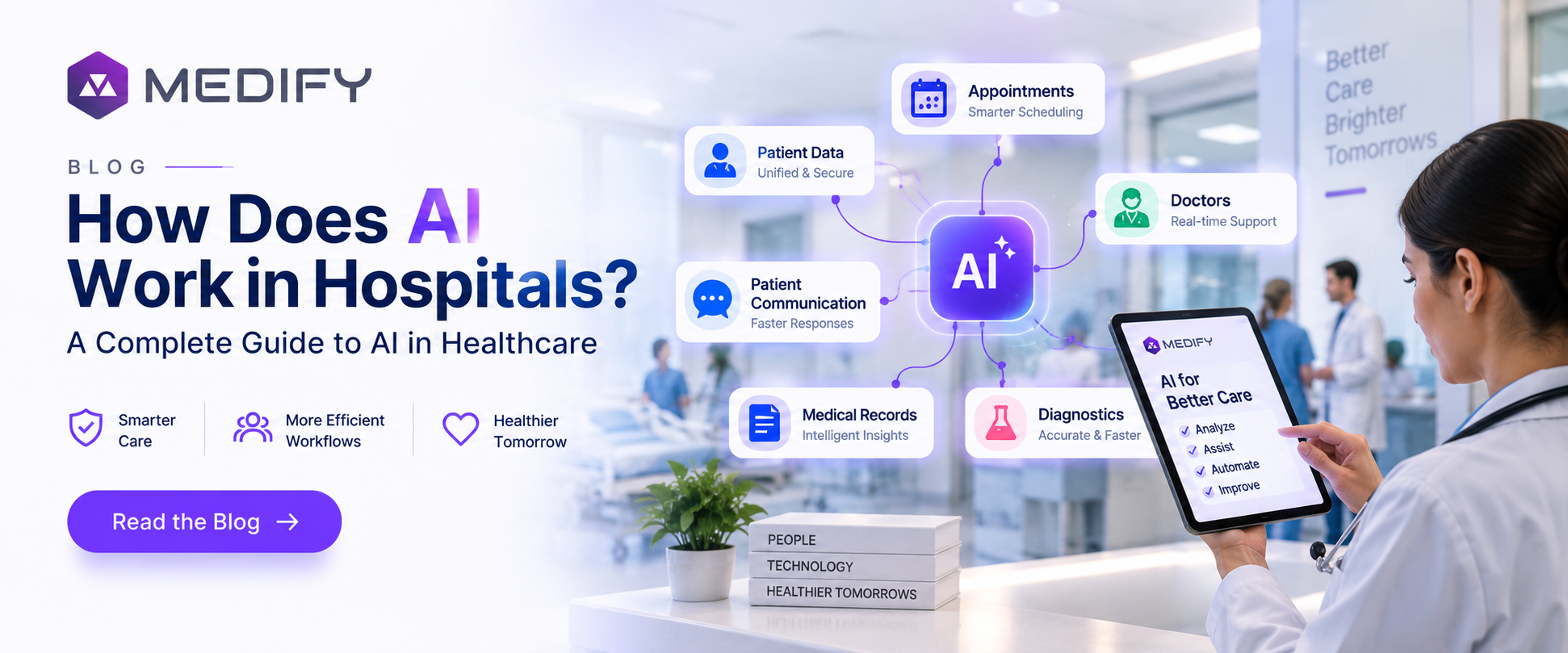
How Does AI Work in Hospitals? A Complete Guide to AI in Healthcare
Artificial intelligence is becoming an important part of modern hospital operations.
Hospitals manage large amounts of information every day, including patient records, medical images, laboratory results, appointments, prescriptions, billing, and patient communication.
AI can process this information, identify patterns, generate insights, support decision-making, automate repetitive tasks, and improve operational workflows.
However, AI in hospitals is much more than a chatbot. It can work across clinical care, administration, patient communication, diagnostics, appointments, billing, and other healthcare workflows.
The FDA’s Artificial Intelligence-Enabled Medical Devices resource notes that AI-enabled medical devices can analyze large and complex datasets and generate information that may support disease detection, diagnosis, treatment, and healthcare delivery.
How Does AI Work in Hospitals?
At a basic level, hospital AI works by processing healthcare data and using trained models to identify patterns, generate predictions, provide recommendations, or automate specific actions.
A simple AI workflow can be understood as:
Data → AI Analysis → Insight → Action
1. Data Collection
AI systems can use information from multiple hospital sources, including:
- Patient records and EHRs
- Hospital management systems
- Laboratory and pharmacy systems
- Medical imaging
- Appointment platforms
- Patient conversations
- Billing and payment systems
2. Data Processing
Healthcare information is often stored across different systems and formats. Relevant data needs to be processed and structured according to the AI application’s purpose.
For example, medical imaging AI processes images, while conversational AI processes patient messages and requests.
3. AI Analysis
The AI model analyzes the available information to identify patterns, understand intent, generate predictions, or provide recommendations.
4. Output and Action
The system can generate a recommendation, alert, summary, response, or workflow trigger.
For example:
Patient Inquiry → AI Understands Intent → Checks Information → Appointment Booking → Confirmation
5. Human Oversight
AI does not necessarily make the final decision. Healthcare professionals can review AI-generated information, while complex or sensitive situations can be escalated to human teams.
AI in Hospitals Is More Than a Chatbot
When people think about healthcare AI, they often think of virtual assistants or chatbots.
In reality, AI can support many different hospital functions, including:
- Patient communication
- Appointment scheduling
- Medical imaging
- Clinical decision support
- Risk prediction
- Patient monitoring
- Documentation
- Hospital administration
- Billing and payments
- Follow-ups and reminders
According to the World Health Organization (WHO) — Harnessing Artificial Intelligence for Health, AI is already being applied in areas including diagnosis, clinical care, disease surveillance, and health systems management.
Where Is AI Used in Hospitals?
1. AI in Medical Imaging
Medical imaging is one of the major areas where AI is being applied.
AI can analyze X-rays, CT scans, MRI scans, ultrasounds, retinal images, and other medical images to identify patterns that may support clinical review.
It can provide an additional layer of information to healthcare professionals rather than automatically replacing them.
Source: FDA — Artificial Intelligence-Enabled Medical Devices
2. Clinical Decision Support
AI can analyze patient information to support healthcare professionals with:
- Risk prediction
- Diagnostic assistance
- Patient classification
- Clinical alerts
- Patient monitoring
- Treatment-related information
The specific capabilities depend on the system, its intended use, and its validation.
3. Patient Communication
AI can automate parts of patient communication through WhatsApp, websites, voice, and other digital channels.
For example, a patient may ask to book an appointment with a cardiologist. AI can understand the request, identify the speciality, collect patient details, provide doctor information, check availability through connected systems, and support booking.
It can also send confirmations and reminders or escalate complex requests to staff.
4. Appointment Automation
Appointment management involves inquiries, doctor selection, availability, bookings, cancellations, confirmations, and reminders.
AI can automate parts of this workflow:
Patient Inquiry → Doctor/Speciality → Availability → Booking → Confirmation → Reminder
When connected to hospital systems, this can reduce repetitive communication and make appointment workflows more consistent.
5. Patient Follow-Ups
AI can support follow-up communication related to:
- Appointment reminders
- Test preparation
- Reports
- Follow-up visits
- Procedures
- Post-visit instructions
This can reduce repetitive manual communication while keeping appropriate workflows in place.
6. Hospital Administration
AI can also support non-clinical operations such as:
- Scheduling
- Documentation
- Billing
- Payments
- Patient registration
- Staff coordination
- Resource management
Automating repetitive administrative work can help healthcare teams focus on tasks that require human involvement.
7. Predictive Analytics
AI can analyze historical and real-time data to identify patterns that may support:
- Patient risk assessment
- Resource planning
- Patient flow
- Demand forecasting
- Equipment monitoring
- Hospital operations
The usefulness of predictive AI depends on data quality, model performance, validation, and how the results are used.
How AI Connects With Hospital Software
AI becomes more useful when it can work with the systems hospitals already use.
These may include:
- HIMS and EHR systems
- Laboratory Information Systems
- Pharmacy management systems
- CRM platforms
- Appointment systems
- Billing and payment platforms
- APIs
Without integrations, AI may only be able to provide information.
With appropriate integrations, it can help move a workflow from:
Conversation → Information → Availability → Action
For example, instead of simply telling a patient when a doctor is available, an integrated AI system may be able to check availability and support the appointment workflow.
This is why healthcare AI needs to be connected to real systems and workflows rather than operate as an isolated chatbot.
Clinical AI vs Administrative AI
Clinical AI | Administrative AI |
Medical imaging | Appointment scheduling |
Clinical decision support | Patient inquiries |
Risk prediction | Billing workflows |
Diagnostic support | Payment communication |
Patient monitoring | Follow-ups and reminders |
Treatment-related support | Documentation |
These areas can also overlap.
For example, an AI patient communication system can connect a patient’s inquiry with the relevant speciality and appointment system.
What Are the Benefits of AI in Hospitals?
When implemented appropriately, AI can support hospitals in several areas.
Faster Information Processing
AI can process large amounts of information and identify relevant patterns based on its intended task.
Reduced Repetitive Work
AI can automate repetitive communication, scheduling, documentation, and administrative processes.
Better Patient Communication
AI can provide patients with faster access to information and guide them through common processes.
Connected Workflows
Integrations can connect patient conversations with hospital systems and operational processes.
Operational Efficiency
Automating repetitive tasks can help healthcare teams spend more time on work requiring human involvement.
Decision Support
AI can provide information, predictions, or recommendations that may support healthcare professionals.
What Are the Challenges of Using AI in Hospitals?
AI also comes with challenges that healthcare organizations need to consider.
Data Quality
Poor, incomplete, or unsuitable data can affect AI performance.
Accuracy
AI systems need to be evaluated for the specific tasks they are designed to perform.
Privacy and Security
Hospitals manage sensitive patient information, making data security and privacy important considerations.
Bias
AI systems need to be evaluated carefully to identify potential bias and differences in performance across relevant populations.
Human Oversight
Complex clinical decisions and sensitive patient situations may require qualified professionals.
Integration
AI needs to work with existing healthcare systems and workflows to deliver meaningful operational value.
The WHO — Ethics and Governance of Artificial Intelligence for Health highlights privacy, bias, accountability, equity, and governance as important considerations for AI in healthcare.
Why AI Should Work With Healthcare Teams, Not Around Them
Hospitals depend on doctors, nurses, administrators, pharmacists, technicians, and other healthcare professionals.
AI can handle appropriate repetitive tasks and provide information, while human teams can manage complex situations.
For example:
- Complex medical questions
- Sensitive patient conversations
- Billing issues requiring intervention
- Requests outside the AI’s knowledge
- Clinical decisions requiring professional judgment
A practical approach is:
AI Handles Routine Work → Human Teams Handle Complex Work
The goal is to support healthcare professionals rather than remove human judgment from healthcare.
Why Medify Takes a Different Approach
Medify focuses on healthcare-specific AI automation for hospitals, clinics, diagnostic centres, and pharmacies.
Instead of simply answering patient questions, Medify AI is designed to understand patient intent, connect with existing healthcare systems, trigger workflows, and support the next action.
Medify supports 3,000+ healthcare providers across 75+ cities and integrates with 40+ healthcare ERP and healthcare management systems.
Its AI solutions can support:
- Patient conversations
- Appointment booking
- Doctor and speciality discovery
- Diagnostic inquiries and bookings
- Pharmacy inquiries and orders
- Patient follow-ups and reminders
- Payment-related workflows
- Healthcare system integrations
- Custom AI workflows
- Human escalation
The objective is to create an intelligent healthcare automation layer that connects conversations with real healthcare workflows.
Medify’s healthcare technology has been implemented across hospitals, clinics, diagnostic centres, pharmacies, and specialty healthcare providers.
Every healthcare organization has different doctors, departments, services, timings, systems, and patient journeys.
That is why healthcare AI needs to be configured around each organization’s specific knowledge, systems, and workflows.
The Future of AI in Hospitals
Hospital AI is moving from individual tools toward connected healthcare workflows.
The evolution can be viewed as:
Digitisation → Automation → AI Assistance → Intelligent Workflows
Future AI systems can connect patient communication, clinical support, predictive analytics, administration, healthcare software, and human teams.
The focus will increasingly shift from what AI can generate to how effectively and responsibly it can support real healthcare workflows.
Source: WHO — Artificial Intelligence for Health
Frequently Asked Questions About AI in Hospitals
How does AI work in hospitals?
AI processes healthcare data, identifies patterns, generates insights, and supports clinical or administrative workflows.
What is AI used for in hospitals?
AI can support medical imaging, clinical decision support, patient communication, appointment scheduling, predictive analytics, administration, monitoring, and follow-ups.
Can AI replace doctors in hospitals?
AI is generally used to support healthcare professionals by providing information, predictions, recommendations, or workflow assistance.
Can AI connect with hospital management systems?
Yes. AI can integrate with HIMS, EHR, laboratory, pharmacy, CRM, appointment, billing, and other healthcare systems through APIs and appropriate integrations.
Is AI used for medical diagnosis?
Yes. AI-enabled technologies can support disease detection, diagnosis, prognosis, and risk assessment, depending on the system and its intended use.
Can Medify AI be used by hospitals?
Yes. Medify AI is designed for hospitals, clinics, diagnostic centres, and pharmacies and can be customized around their workflows.
Conclusion
AI is changing how hospitals process information, support healthcare professionals, communicate with patients, and manage operations.
But effective hospital AI is more than a chatbot. It needs to work with healthcare data, existing systems, operational workflows, and human teams.
The real value comes when AI capabilities are connected to meaningful actions:
Data → AI → Insight → Action
As hospitals continue adopting AI, the focus will increasingly move from isolated AI tools toward connected, workflow-driven healthcare automation.
Medify AI helps hospitals, clinics, diagnostic centres, and pharmacies turn healthcare conversations and workflows into actions through AI automation, healthcare integrations, and patient communication solutions.
Explore AI-Powered Healthcare Automation with Medify
Discover how Medify helps automate patient communication, appointment booking, follow-ups, diagnostics, and pharmacy workflows through AI.