

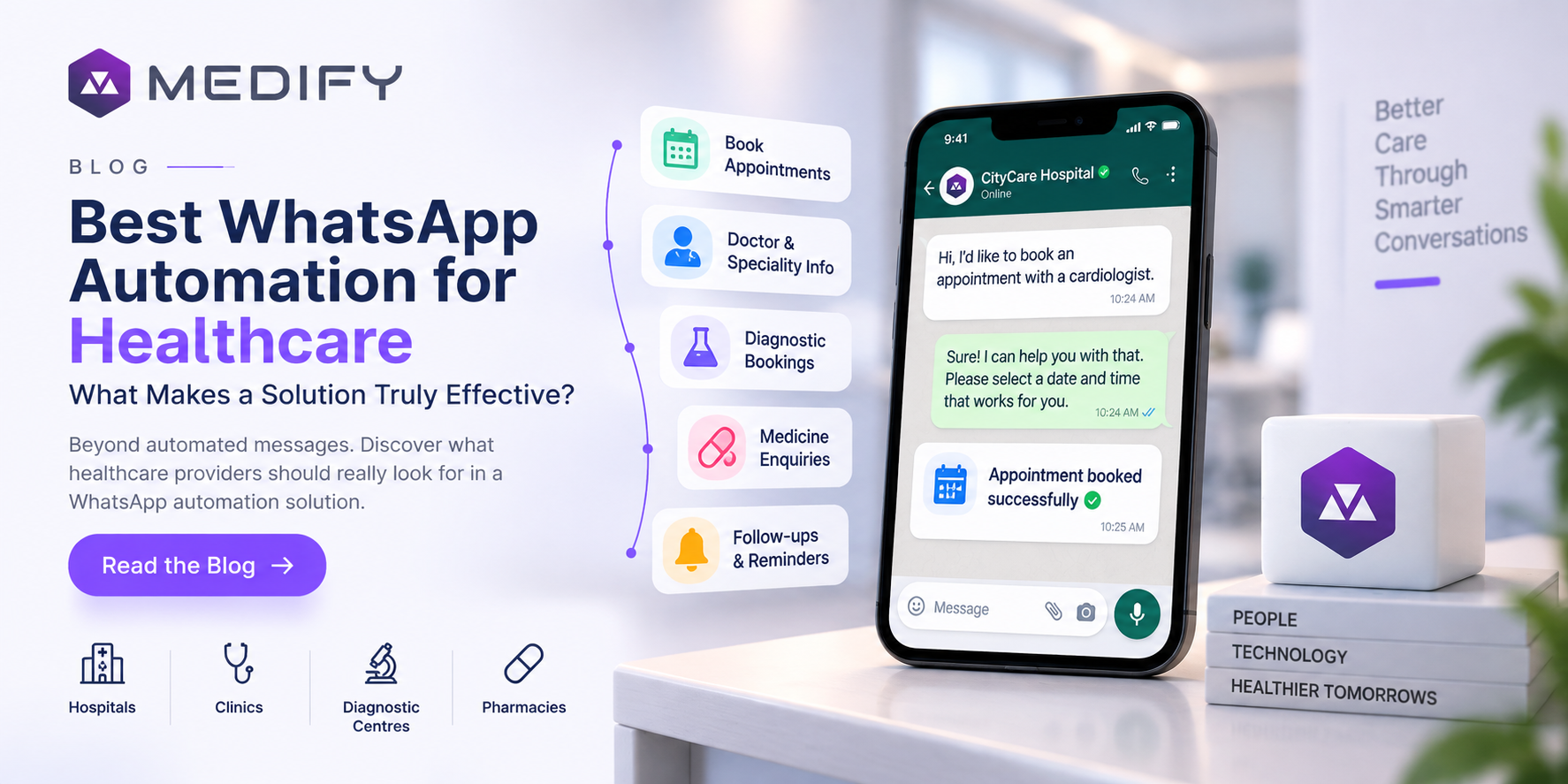
Best WhatsApp Automation for Healthcare: What Makes a Solution Truly Effective?
Healthcare providers are increasingly using WhatsApp to communicate with patients, manage enquiries, schedule appointments, and support everyday operations.
With hundreds of WhatsApp automation tools now available, choosing a solution can appear straightforward.
But healthcare automation is not the same as automating customer conversations for a typical business.
A hospital manages appointments, doctors, departments, procedures, patient communication, and multiple operational systems.
A diagnostic centre manages tests, preparation instructions, bookings, reports, and patient follow-ups.
A pharmacy manages medicine enquiries, orders, payments, availability, and delivery.
The complexity lies not in connecting AI to WhatsApp.
The real challenge is building automation that understands healthcare workflows and can reliably turn conversations into actions.
This is what separates generic WhatsApp automation from healthcare-specific automation.
Source: World Health Organization (WHO) — Ethics and Governance of Artificial Intelligence for Health
WhatsApp Automation Is Easy. Healthcare Automation Is Not.
Today, almost any business can automate WhatsApp messages. Businesses can create chatbots, configure automated replies, send reminders, collect information, and build predefined conversation flows.
The technology is increasingly accessible.
But healthcare requires much more than automated messaging.
Healthcare providers manage:
- Patient enquiries
- Appointment scheduling
- Doctor and speciality information
- Procedure-related communication
- Diagnostic test information
- Patient instructions
- Pharmacy workflows
- Payments
- Follow-ups
- Multiple healthcare software systems
Every conversation can be connected to an operational process.
An appointment enquiry may require speciality selection, doctor availability, slot selection, patient details, confirmation, payment, and reminders.
A pharmacy enquiry may involve medicine availability, prescription requirements, ordering, payment, and delivery.
This means WhatsApp is not simply a communication channel.
It can become part of the operational workflow.
Simply adding a chatbot to WhatsApp does not automatically create that value.
Successful healthcare automation requires a combination of AI, workflow design, healthcare knowledge, integrations, and operational understanding.
Source: World Health Organization (WHO) — Ethics and Governance of Artificial Intelligence for Health
What Healthcare Providers Should Actually Look For
When healthcare organizations evaluate WhatsApp automation, the focus should not only be on chatbot features.
The more important consideration is how deeply the technology can support the organization’s actual workflows.
1. Intelligent Conversation Management
Patients rarely communicate like structured forms.
They describe what they need in their own words.
A patient may want to find a specialist, understand a procedure, check diagnostic preparation requirements, or reorder medicines without following a predefined conversation path.
Healthcare AI needs to understand intent and context rather than simply matching keywords.
This allows the system to respond more naturally and guide the patient toward the appropriate next step.
The goal is to move from automated replies to intelligent conversations.
Source: PubMed / NIH — Conversational Agents in Health Care
2. Action-Oriented Automation
The value of WhatsApp automation increases significantly when conversations can trigger actions.
- An appointment conversation can progress toward booking.
- A pharmacy enquiry can progress toward an order.
- A patient request can trigger a follow-up.
- A diagnostic enquiry can lead to the relevant test information or booking process.
This creates a connected workflow:
Conversation → Understanding → Decision → Action
Instead of simply providing information, automation becomes part of the operational process.
3. Healthcare-Specific Knowledge
Every healthcare organization has its own information and processes.
Doctors, departments, procedures, services, timings, locations, instructions, pricing, policies, and workflows can vary significantly between organizations.
A generic AI model cannot simply be deployed and expected to understand all of this accurately.
Healthcare automation needs to be configured around the organization’s specific knowledge and requirements.
This allows AI to provide more relevant and consistent communication while maintaining alignment with the organization’s processes.
Source: World Health Organization (WHO) — WHO Calls for Safe and Ethical AI for Health
4. Appointment and Patient Journey Automation
Appointment management is one of the most important applications of WhatsApp automation.
Patients can use WhatsApp to enquire about doctors, select specialities, check availability, schedule appointments, receive confirmations, and receive reminders.
The same channel can support follow-ups and other parts of the patient journey.
For healthcare teams, this can reduce repetitive administrative work.
For patients, it creates a simpler communication experience.
The real benefit comes when appointment automation is connected to the systems that manage availability and scheduling.
Source: PubMed / NIH — Applications of Artificial Intelligence-Based Conversational Agents in Healthcare
5. Deep Healthcare System Integrations
Most healthcare organizations already use multiple software systems.
These may include:
- Hospital Management Systems
- Clinic Management Systems
- Laboratory Information Management Systems
- Pharmacy Management Platforms
- CRM systems
- Appointment platforms
- Payment systems
- APIs
A WhatsApp automation platform that operates independently from these systems can only automate a limited part of the workflow.
Integrations are what allow conversations to become operational actions.
When WhatsApp connects with existing healthcare software, organizations can create more seamless workflows without forcing staff to manually move information between different platforms.
Source: HL7 — FHIR (Fast Healthcare Interoperability Resources)
Source: U.S. Office of the National Coordinator for Health Information Technology (ONC) — FHIR
6. Human Handover and Escalation
Healthcare automation should not attempt to automate every interaction.
Some conversations require human involvement.
Complex requests, sensitive situations, billing concerns, exceptions, and interactions outside the system’s knowledge may need to be handled by staff.
A strong healthcare automation platform therefore needs to support both AI and human teams.
The AI can manage routine and repetitive interactions.
More complex conversations can be escalated to the appropriate staff member.
This creates a model where automation improves efficiency without removing the human element from healthcare communication.
Source: World Health Organization (WHO) — Ethics and Governance of Artificial Intelligence for Health
7. Flexibility Across Healthcare Segments
Healthcare organizations do not operate in the same way.
A hospital may need automation for appointments, departments, procedures, patient guidance, and follow-ups.
A clinic may focus more heavily on appointment scheduling, enquiries, reminders, and patient engagement.
A diagnostic centre may need automation around tests, preparation instructions, bookings, home collection, and reports.
A pharmacy may require medicine enquiries, availability, ordering, reorders, payments, and delivery communication.
A healthcare automation platform therefore needs to be flexible enough to support different workflows rather than forcing every organization into the same model.
The Hidden Limitations of Basic WhatsApp Automation
Many WhatsApp automation solutions focus primarily on automated messaging.
They may provide predefined responses, menu-based conversations, notifications, and simple workflows.
These features can be useful. However, they often address only one part of the problem.
Healthcare organizations require automation that can work across the entire communication journey.
This includes understanding patient intent, accessing relevant information, connecting with operational systems, triggering actions, maintaining context, and escalating conversations when necessary.
The difference between basic automation and intelligent healthcare automation is not the number of features.
It is the depth of the workflow being automated.
A platform that simply answers questions may reduce some workload. A platform that can understand, decide, execute, and escalate can become part of an organization’s operational infrastructure.
Source: PubMed / NIH — Conversational Agents in Health Care
Why ROI Matters More Than WhatsApp Software Pricing
Healthcare providers often compare automation platforms based on subscription costs.
But software pricing alone does not determine the value of automation.
The more important consideration is what the system can improve.
Effective WhatsApp automation can help healthcare organizations achieve:
Faster patient response times
Reduced repetitive administrative work
More efficient appointment management
Better patient engagement
Improved follow-up processes
More consistent patient communication
Scalable communication workflows
Greater operational efficiency
When these outcomes are considered, the lowest-priced platform is not necessarily the most cost-effective solution.
The real value lies in how much operational work the technology can successfully automate.
Source: PubMed / NIH — Applications of Artificial Intelligence-Based Conversational Agents in Healthcare
Why Medify Takes a Different Approach
At Medify, healthcare automation is built around a simple principle:
AI should not just answer patients — it should help healthcare businesses complete the next action.
Medify brings healthcare-specific technology expertise and real-world implementation experience to WhatsApp automation.
Medify has built and implemented digital healthcare solutions for hospitals, clinics, diagnostic centres, and pharmacies, helping healthcare businesses automate patient communication and connect conversations with operational workflows.
With experience supporting 3,000+ healthcare providers across 75+ cities and integrating with 40+ healthcare ERP and healthcare management systems, Medify understands the operational complexity behind healthcare communication.
This includes workflows across:
Appointments
Patient enquiries
Pharmacy orders
Diagnostic bookings
Payments
Follow-ups
Patient engagement
Healthcare system integrations
Medify Healthcare Automation: At a Glance
| Capability | Medify |
|---|---|
| Healthcare providers supported | 3,000+ |
| Cities covered | 75+ across India |
| Healthcare system integrations | 40+ |
| Healthcare segments | Hospitals, clinics, diagnostic centres, pharmacies |
| Core technology | AI and workflow automation |
| Key use cases | Appointments, pharmacy, diagnostics, patient engagement, follow-ups |
| Integrations | Healthcare ERP, HIMS, and other healthcare technology systems |
Medify’s healthcare technology solutions have been implemented across a diverse range of healthcare organizations, including pharmacy networks, hospitals, clinics, diagnostic centres, and specialty healthcare providers.
Its client ecosystem includes organizations such as Noble Plus, Emami Frank Ross Pharmacy, Aster Pharmacy, Kokilaben Dhirubhai Ambani Hospital, Saifee Hospital, Patil ENT Hospital, and Raghunath Netralaya Eye Care & Research Institute, along with other healthcare businesses across India.
This implementation experience is important because healthcare automation cannot be designed like a generic customer-service chat
Conclusion
There is no shortage of WhatsApp automation tools in the market.
But healthcare providers need more than automated messages and predefined chatbot flows.
They need solutions that understand healthcare workflows, communicate naturally with patients, integrate with existing systems, automate meaningful actions, and support human teams when necessary.
Effective healthcare WhatsApp automation is not about the number of messages a platform can automate.
It is about how effectively the technology can support the complete patient and operational journey.
As healthcare organizations continue to adopt AI, the value of automation will increasingly depend on how effectively it is applied to real patient and business workflows.
And that is where healthcare-specific WhatsApp automation creates its real value.
Medify AI helps hospitals, clinics, diagnostic centres, and pharmacies turn patient conversations into actions through intelligent WhatsApp automation combining healthcare expertise, AI-powered workflows, and integrations with existing healthcare systems.
About Medify
Medify is a healthcare technology company focused on AI-powered automation, healthcare CRM, analytics, and healthcare system integrations.
Its platform helps hospitals, clinics, diagnostic centres, and pharmacies digitize patient interactions and connect them with operational workflows.
Medify supports 3,000+ healthcare providers across 75+ cities and integrates with 40+ healthcare ERP and healthcare management systems, helping healthcare businesses move from simple digital communication to connected, action-oriented healthcare automation.
Explore AI-Powered Healthcare Automation with Medify
Discover how Medify helps automate patient communication, appointment booking, follow-ups, diagnostics, and pharmacy workflows through AI.