

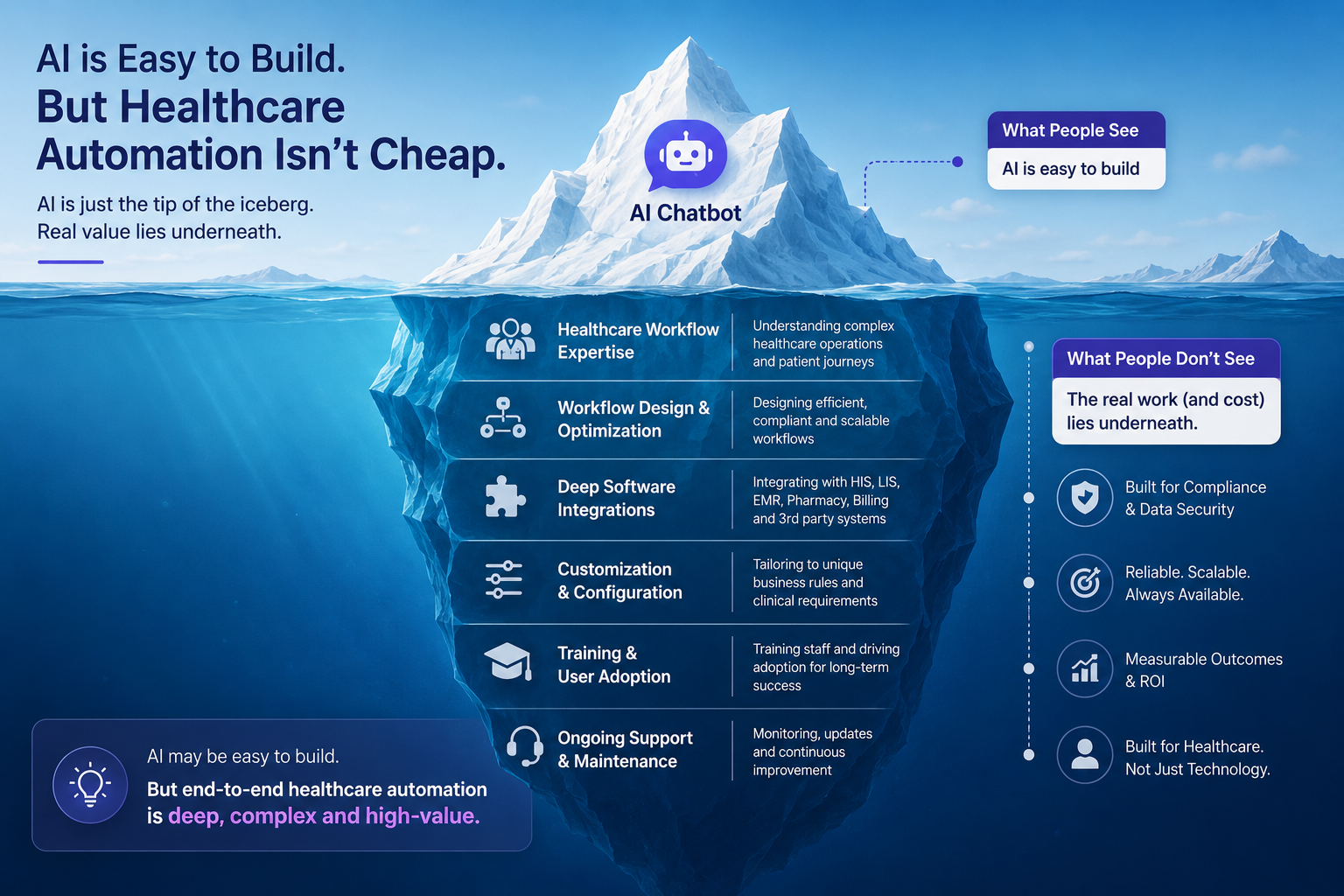
If AI Is Easy to Build, Why Isn't Healthcare Automation Cheap?
Healthcare providers exploring automation often ask us a simple question:
“If anyone can build an AI automation tool today, shouldn’t healthcare automation be significantly cheaper?”
At first glance, the question makes sense.
AI tools are becoming increasingly accessible. Businesses can build chatbots, automate conversations, and create workflows faster than ever before.
But healthcare automation is not simply about having access to AI.
The real challenge is building solutions that work reliably within the complexity of healthcare operations.
From appointment booking and patient communication to pharmacy workflows and diagnostic follow-ups, healthcare organizations require systems that do much more than send automated messages.
This is where the difference between generic AI tools and healthcare automation platforms becomes clear.
AI Is Easy to Access. Healthcare Expertise Is Not.
Today, almost anyone can build a chatbot.
Anyone can automate messages.
Anyone can connect AI to a workflow.
The technology itself is no longer the differentiator.
The real value lies in understanding how healthcare organizations operate and how technology can improve those operations without disrupting patient care.
Healthcare providers manage:
- Patient inquiries
- Appointment scheduling
- Follow-ups and reminders
- Pharmacy workflows
- Diagnostic communications
- Multiple software systems
- Staff coordination
Every workflow impacts both patient experience and operational efficiency.
Simply adding AI into the process does not automatically solve these challenges.
Successful healthcare automation requires deep industry understanding, workflow expertise, and operational alignment.
What Healthcare Providers Are Actually Investing In
When healthcare organizations adopt automation, they are not paying for an AI subscription.
They are investing in a system designed to improve how their business operates.
1. Healthcare Workflow Expertise
Healthcare is unlike any other industry.
Patient journeys, appointment management, treatment follow-ups, pharmacy coordination, and administrative processes all require specialized understanding.
Building automation that supports these workflows effectively requires healthcare-specific expertise.
2. Workflow Design and Optimization
Automation should improve operations, not simply digitize existing inefficiencies.
Before technology can create value, workflows often need to be redesigned and optimized.
This helps healthcare organizations:
- Reduce administrative workload
- Improve patient communication
- Increase operational efficiency
- Deliver better patient experiences
3. Customization for Every Healthcare Organization
No two healthcare providers operate exactly the same way.
A multispecialty hospital has different requirements than a clinic.
A pharmacy has different workflows than a diagnostic centre.
A one-size-fits-all approach rarely delivers meaningful results.
Healthcare automation often requires customization to fit specific operational requirements.
4. Deep Software Integrations
Most healthcare organizations already rely on multiple software systems.
These may include:
- Hospital Management Systems (HMS)
- Electronic Medical Records (EMR)
- Practice Management Software
- Pharmacy Management Platforms
- CRM Systems
- Communication Platforms
The value of automation comes from connecting these systems into a seamless workflow.
Without integration, organizations often end up creating additional operational complexity.
5. Training, Adoption, and Support
Technology only creates value when teams use it successfully.
Implementation is only the beginning.
Healthcare organizations often require:
- Staff training
- Workflow onboarding
- Adoption support
- Continuous optimization
These services play a critical role in ensuring long-term success.
6. Infrastructure That Scales
As healthcare organizations grow, communication volumes increase.
Patient interactions expand.
Operational complexity rises.
Automation infrastructure must be designed to scale alongside the business while maintaining reliability and performance.
7. Accountability and Long-Term Partnership
Healthcare providers are not simply purchasing software.
They are trusting a partner with critical operational processes.
Successful healthcare automation requires ongoing support, optimization, and accountability long after implementation is complete.
The Hidden Cost of Low-Priced Healthcare Solutions
The healthcare technology market is filled with solutions offering extremely low entry prices.
While these options may appear attractive initially, pricing alone rarely determines long-term success.
The more important question is:
- What happens after implementation?
- Who helps redesign workflows?
- Who trains staff?
- Who supports adoption?
- Who identifies operational bottlenecks?
- Who continuously improves the system?
- Who ensures the solution continues delivering value as the organization grows?
Customer success requires expertise, infrastructure, and long-term commitment.
These investments often determine whether automation becomes a business asset or simply another software subscription.
Why ROI Matters More Than Software Pricing
Many healthcare providers evaluate technology based on monthly subscription costs.
However, the true measure of value is return on investment.
Effective healthcare automation can help organizations achieve:
✓ Faster patient response times
✓ Reduced administrative workload
✓ Improved appointment conversions
✓ Better patient engagement
✓ Increased operational efficiency
✓ Scalable communication processes
When measured against these outcomes, the lowest-priced solution is not always the most cost-effective solution.
Why Medify Takes a Different Approach
At Medify, we believe healthcare automation should deliver measurable business outcomes.
Our focus is not simply building AI-powered tools.
Our focus is helping healthcare providers improve operations through technology.
This includes:
- Healthcare-specific automation workflows
- Patient communication automation
- Appointment booking automation
- Pharmacy workflow automation
- Diagnostic communication automation
- System integrations
- Ongoing implementation and support
Because successful automation is not about deploying software.
It is about creating operational improvements that healthcare organizations can measure.
The Future of Healthcare Automation
The healthcare industry does not lack software providers.
What it often lacks are partners who understand healthcare operations deeply enough to create meaningful impact.
As AI becomes increasingly accessible, the competitive advantage will not come from who has access to technology.
It will come from who can successfully apply that technology to improve patient experiences, streamline operations, and drive sustainable growth.
Conclusion
Technology has never been easier to build.
But building healthcare automation systems that consistently improve operations, increase efficiency, and deliver measurable ROI remains a significant challenge.
Healthcare organizations are not investing in AI alone.
They are investing in expertise, integrations, implementation, support, infrastructure, and accountability.
That is where the real value of healthcare automation exists.
And that is why healthcare automation is not priced based solely on access to AI.
Explore AI-Powered Healthcare Automation with Medify
Discover how Medify helps automate patient communication, appointment booking, follow-ups, diagnostics, and pharmacy workflows through AI.